
Range anxiety is over. How I did 750 km in one day with a small affordable EV
By Steffen Schaefer, Head of Mobility and Transport, AFRY
Drivers of combustion-engine vehicles often argue that electric vehicles offer insufficient driving range and are too expensive. Living in southern Germany, I have spoken to many people over the years who told me they would buy an electric car if they could still “visit family in the North” or “drive to the ski slopes in winter”. Both are considered impossible by people who haven’t even tried, which is why I decided to put it to the test. It turns out that driving hundreds of kilometers can absolutely be done with an affordable mass market electric car – also in winter.
The quest for the electric mass market car
From my perspective, electric cars are the better cars. The high torque makes them fun to drive, they are three times more energy‑efficient and thus have lower operating costs, and they produce no noise, fumes, or local carbon emissions.
As a passionate EV driver for many years, I have driven a range of electric vehicles across all segments, including models from Tesla, Lucid, BMW, Mercedes, Volkswagen, Cupra, Skoda, Citroen, Volvo, and BYD. The car I’m driving since a few months is the Renault 5 E-Tech. A car subscription for long-term rental allows me to switch models easily while giving me certainty to always have a car available, parked at home in my garage. I do this to better understand the state of the market, most importantly the user experience at the intersection of the electric car, charging infrastructure, and the power grid.
For me, this user experience is defined by two key factors. First: the availability of charging infrastructure and sufficient power at the right place and time. Second: the ease of use of the chargers - which depends on the success rate of the charging process including the interaction with the charger. This process can sometimes be affected by interoperability issues between vehicle, charging hardware, backend systems, and payment solutions - and is gradually improving. As a software engineer by training, I am particularly interested in this user experience involving also the digital layer, where many of today’s frictions and opportunities for improvement, still lie.
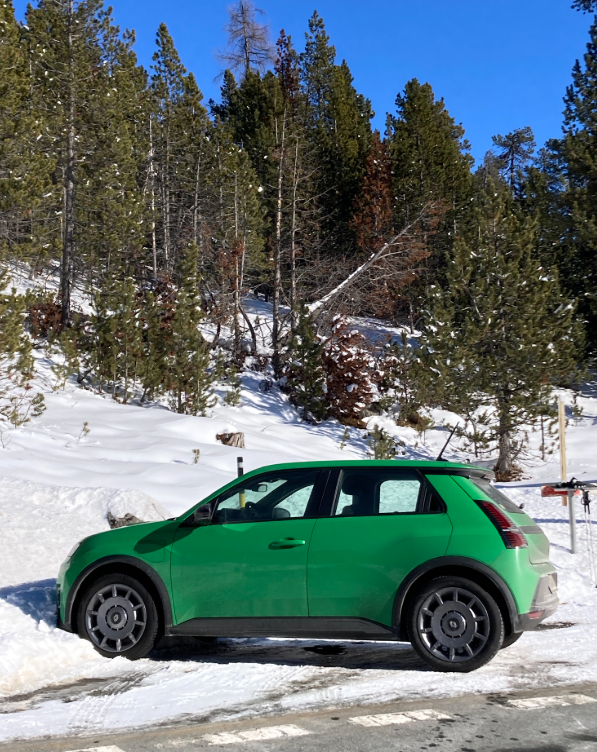
Renault 5 in the Italian Alps (photo: Steffen Schaefer).
Among all the models I have mentioned above, the Renault 5 E-Tech Urban Range that I currently drive has been an eye opener for me. The car is small, agile, and relatively light, with a 42 kWh NMC battery and a powerful 90 kW (122 hp) motor. At first glance, it almost feels counter-intuitive to consider it for long journeys.
Renault has obviously developed this version with a clear understanding that the average daily driving distance of a passenger car in Europe is around 30 km, and that purchase cost is a decisive factor for many buyers. Using a small battery helps keeping costs down, making the vehicle roughly cheaper than the few other cars in this category. When no climate control is required, the vehicle consumes around 16 kWh/100 km at cruising speeds of 115–125 km/h, translating into a practical driving range of approximately 240 km. In winter when the heat pump is in use, energy consumption increases to around 19 kWh/100 km, reducing the practical range to around 200 km. The somewhat elevated energy consumption of this small and relatively light car is most likely due to the winter tires.
Long-haul trips in winter – even with a 42-kWh battery
While the range of the car doesn’t sound like much, in practice it turned out to meet my needs even for long-haul trips. Living in Munich’s city center, I don’t use the car within the city. Instead, I love driving to surrounding lakes and mountains and even on long-distance trips. The vehicle accommodates skis, equipment, and luggage, and over the past winter took my wife and me on several skiing trips from Munich to Italy, and another one to Switzerland.
For long‑haul trips, especially cross‑border travel, I prefer chargers from IONITY and Tesla. They offer strong regional coverage, are reliable, and most locations provide a café or restaurant as well as restroom facilities.
I got to see some stunning places. My favorite of all was the IONITY station at Lake Silvaplana in the Engadin region of Switzerland. It is conveniently situated along an arterial road to serve long-haul traffic. But as it is also directly located at the shores of Lake Silvaplana with its cross-country slopes, it can also be used as a destination charger - of course EV drivers should only go for a short round on the frozen lake, to not occupy the HPC station unproductively. The charging site has been very popular every time I’ve been there. Two pull-through charge points are also available for cars with a trailer, or even trucks; and IONITY has placed a vending machine for chocolate bars and soft drinks.
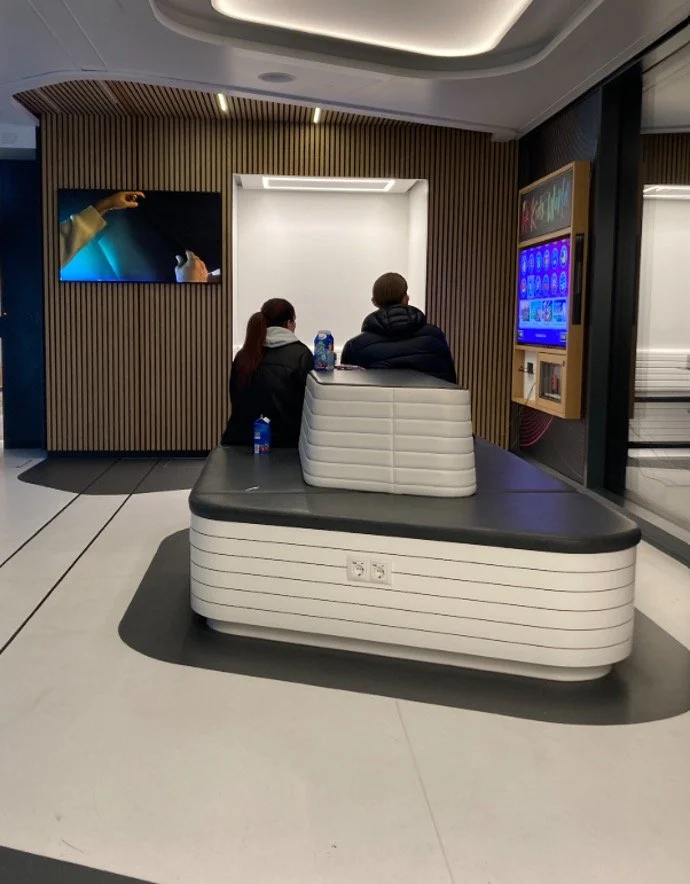
Amenities at one of the charging stations (photo: Steffen Schaefer).
Even though the specs say slightly more, charging speed with the Renault 5 peaked at 65 kW in real‑world winter conditions. As usual, at higher State of Charge (SOC) - after getting to 40% - charging speeds slows down significantly. For the 42 kWh-battery this means a 25–30-minute break for bringing the battery back to 90%.
On another occasion, I completed a long-haul trip from Munich to Freiburg and back in one single day – a total distance of 750 km. Although it required four charging stops during the day – in average of around 20 minutes - I made it without any issues. My usual cruising speed of 115–125 km/h is, of course, not particularly fast by German standards. The Renault 5 E‑Tech has a top speed of 150 km/h, but at higher speeds the practical driving range can drop to less than 150 km.
This is something many EV newcomers experience: enjoying the performance at first, only to be surprised by how quickly the remaining range decreases. As the Renault 5 is not among the fastest‑charging EVs, I prefer setting the cruise control to 125 km/h and drive in a more energy‑efficient and relaxed manner.
One of the highlights of my trip to Freiburg was a stop at a Tesla charging hub near Stuttgart. With a dedicated lounge, vending machines for soft drinks and ice cream, an automated pizza oven, and gaming consoles, it was a great example of how charging stops are evolving. The charging session here was almost too short!
Affordable EVs gain traction
For those who care more about performance than about price, various models with practical range above 600 km are available from Mercedes, Audi, Lucid. Tesla, and Polestar. BMW has joined this club with the new iX3 'Neue Klasse'. Especially the BMW iX3 and the Mercedes CLA have quickly gained strong sales momentum and have full order books.
To make EVs a thing for the mass market though, prices need to drop below € 30,000, and this segment has been neglected in the past years. Back in 2021, the German small and compact car segment (A and B) accounted for 50–60% of all electric vehicle sales. This share declined sharply to just 10–15% in 2025 (see below chart – source: NOW).
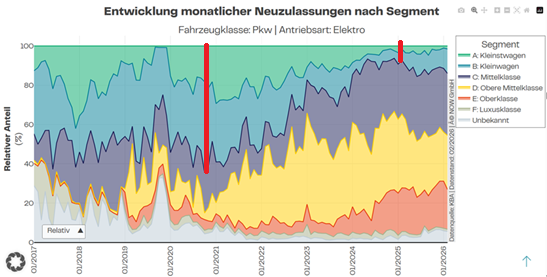
Electric compact car sales in Germany. Source: NOW.
The cheapest version of Renault 5 E-Tech Urban Range without subsidies costs around € 25,000, which is a price point that makes good electric cars affordable for a large group of customers. And the Renault 5 is not an isolated case. More affordable EV models are finally entering the market. European OEMs have unveiled multiple models below €30,000 that will hit the market starting this year: Volkswagen’s ID.Polo and ID.Cross, Renault’s Twingo and Renault 4, Skoda's Epiq, or Fiat's Grande Panda Electric. Korean and Chinese OEMs are offering more alternatives. New government incentives for low-income groups will bring down the cost of some of the models even down to € 20,000.
LFP batteries are going to be widely used in this segment, which will bring down cost by 20-25%. LFP batteries are more durable and even suited for charging regularly to 100% SOC. Unlike other battery chemistries, regular full charging has far less negative impact on long‑term battery health. However, LFP batteries come with lower charging speeds.
Why the new car segment matters for charge point operators
The new BEV models in the compact segment are going to change what we see on the roads today. And with the sky-high petrol prices that we seen now, I predict these new vehicles are going to sell well. The second-hand market is also accelerating, and thus affordable electric vehicles will finally find their way into the mass market.
Charge point operators should take note about this change as it has various consequences:
Most importantly: the higher penetration of EV in the fleet due to their affordability will bring up the number of sessions, energy consumed, and revenue per charger quite significantly. For Germany in the next ten years, AFRY Management Consulting predicts an increase of BEVs by a factor of 8-10 and growth of the energy consumed by BEV by a factor of 12-15.
The new mass market customer segment relies more heavily on public charging than previous EV user groups. A much smaller share than current EV drivers lives in places where own wall boxes can be installed.
Cars in the mass market segment are charging at much lower charging speeds than high-end models -and will even in the future offer 'only' 150-200 kw peak, and maybe 100-150 kW average power between SOC from 10-90%. C-rates in this segment can be expected to range between 3-5C. Average energy sold per session will not increase as fast as we saw in the past years, due to the smaller batteries.
As more BEV will charge publicly, LFP batteries charge slower and can handle 90-100% SOC average dwell times won't get much shorter, requiring more chargers at the charging hub.
The unavoidable - but positive - transition to EVs
Driving long distances—even in winter—has become entirely feasible with electric cars, including small and affordable models with modest battery size. A dense and reliable charging network, combined with high charging speeds, makes this very possible.
Long trips still require some planning: charging stops must be chosen carefully, taking the vehicle’s range into account. That said, many charging hubs have evolved into attractive destinations in their own right, offering real value and making breaks more enjoyable.
If you haven't tried, I strongly encourage you to experience it yourself—give electric cars a try!
With this article, I hope to inspire more EV drivers to share their experiences and create more positive narratives that will help electric mobility flourish.
-
Yes. Even with a 42 kWh battery, long-distance travel is entirely feasible. In real-world winter conditions, you can expect around 200 km of range per charge. With a well-developed fast-charging network, this translates into manageable driving segments and regular breaks.
-
On a 700–800 km trip, expect around 3–5 charging stops. Each stop typically lasts 20–30 minutes, depending on how much you recharge and the charger’s speed. These breaks often align naturally with rest stops for food or coffee.
-
Winter does reduce range due to heating and colder battery temperatures. In this case, consumption increased from about 16 kWh/100 km to around 19 kWh/100 km. However, even in winter, long trips remain practical with proper planning.
-
Not anymore. Affordable models like the Renault 5 E-Tech start at around €25,000, and several new models are entering the market below €30,000. With incentives, some may approach €20,000, making EVs accessible to a much broader audience.