
Our Positions
EV charging issues cross many policy areas - consumer affairs, energy, IT & cyber, automotive, manufacturing, and many more.
Search below to find our position papers on the topics of interest to you.
Please Plug the Gap Between the Truck and the (Charging) Station: Breaking the eHDV Investment Deadlock
Introduction
The electrification of heavy-duty road transport will require a rapid and large-scale rollout of dedicated charging infrastructure across Europe. Yet while the policy debate often focuses on rollout targets and upfront capital expenditure, a central obstacle remains insufficiently addressed: in the early years of market development, demand for public eHDV charging is too uncertain to support investment at the pace and scale required.
eHDV charging infrastructure is capital-intensive and grid-intensive, with long payback periods. Investors typically rely on anchor customers or long-term offtake agreements, yet these are difficult to secure in a market where fleet uptake depends on multiple factors — including total cost of ownership (TCO), operational requirements, vehicle availability and route structures — and where the pace and timing of the transition remains highly uncertain. This uncertainty is not only commercial, but also policy-driven: while a stable and supportive framework for eHDV uptake can strengthen confidence in future demand, recent developments — including the postponement of ETS2 to 2028 and additional flexibility in HDV CO2 standards — have further weakened short-term visibility on the likely pace of e-truck adoption. Similarly, while some Member States are looking to introduce demand-side measures such as decarbonisation targets for shippers, these are enjoying limited political momentum at EU level.
As a result, charging operators cannot reliably predict early utilisation or revenue trajectories. For lenders and investors, this makes it difficult to assess whether and when a project will become commercially viable. Projects may therefore face significantly higher financing costs as the risk of low early utilisation is priced in, or struggle to secure funding at all.
Existing public support instruments can help reduce upfront investment costs, but they do not by themselves solve the problem of low and uncertain utilisation in the first years of operation. Other barriers — such as high grid connection costs, long lead times, permitting delays and fragmented implementation — remain relevant and can further weaken project economics, but are secondary to, or closely linked with, the underlying issue of uncertain demand.
The result is a familiar coordination problem: charging infrastructure providers hesitate to invest without credible demand; fleet operators delay commitments until TCO is favourable and infrastructure is in place; and manufacturers cannot scale vehicle sales without commitments from either side. This dynamic slows market activation, even where long-term demand is clear.
This paper seeks to outline possible approaches to resolve this coordination problem, prioritising approaches that target early-stage deployment where risk is highest, provide partial risk coverage in order to preserve market incentives, avoid excessive administrative or implementation complexity, and do not grant specific actors disproportionate control over the wider ecosystem. Measures should also be coherent with existing frameworks such as AFIR, AFIF and InvestEU, adaptable to different use cases and locations [1], and sufficiently scalable and replicable to support wider market rollout.
Not all measures are created equal. Some can be implemented quickly within existing frameworks and may improve investment conditions at the margins. Others are more complex to design and deploy, but more directly address the core challenge of early-stage utilisation risk.
The paper therefore adopts a structured “menu” approach, ranging from readily implementable measures to more ambitious de-risking mechanisms. The aim is not to present interchangeable options, but to distinguish clearly between incremental improvements and those measures with the potential to unlock investment at scale.
Short-term adjustments to existing instruments
Lower ambition, limited but near-term impact
A first category of measures consists of relatively simple adjustments to existing funding instruments that could improve investment conditions for eHDV charging infrastructure in the short term. In particular, ChargeUp Europe has already laid out recommendations to adapt the Alternative Fuels Infrastructure Facility (AFIF) in 2025 [2], which are mirrored in our recommendations below.
These measures are lower in ambition than dedicated de-risking mechanisms and do not directly resolve the core challenge of uncertain early utilisation. However, they may still alleviate cost, timing and administrative constraints, and are therefore worth considering as part of a broader policy response:
A) Longer and more flexible implementation timelines
In many cases, the timeline for public eHDV charging projects is determined less by the charging equipment itself than by permitting and, above all, grid connection processes, which are out of the control of the charging operator. Existing funding frameworks should therefore not only allow for extensions where justified, but proactively provide longer and more realistic implementation timelines in call design from the outset, better reflecting the realities of permitting and grid connection processes. The current mismatch is already causing hesitance among companies to apply for funding, and where funding is rewarded ultimately viable projects may lose support, be delayed, or fail to proceed, simply because administrative or grid-related lead times are longer than assumed under existing schemes.
B) Better account for grid connection costs in AFIF and similar schemes
For large public eHDV charging hubs, grid connection costs can represent a significant share of total project costs and may be substantially higher than for standard LDV charging sites. While grid connection costs are in principle eligible under the AFIF co-funding scheme, current funding structures do not adequately reflect the scale and variability of grid investments required for eHDV infrastructure. As a result, a substantial portion of grid-related costs remain insufficiently addressed. A first priority should therefore be to ensure that AFIF and similar instruments better account for the grid connection costs associated with eHDV charging infrastructure.
This could include reimbursement mechanisms that cover eligible grid connection costs at an early project stage, rather than only after charging revenues begin to materialise, following the good practice of existing national examples [3]. Simplifying the administrative process for obtaining such support — for example through more streamlined application procedures — could further improve the effectiveness of such mechanisms.
C) More flexible site-selection and design rules
Rigid site-selection requirements may exclude technically or commercially viable locations with better grid access or more realistic deployment prospects (e.g. AFIF requirement to be within three km from the TEN-T network). This issue may be even more pronounced for large eHDV hubs, which have more demanding space and power requirements than LDV charging sites. To the extent that existing funding instruments add avoidable rigidity, these should be made more flexible. More fundamentally, however, the forthcoming AFIR review should assess whether the current siting logic remains fit for purpose for eHDV charging infrastructure, given the particular space and grid requirements of large public hubs.
Similar flexibility may also be warranted in regard to technology and site design. For example, while MCS is likely to become increasingly widespread and important for HDV charging over the coming years, allowing some flexibility in choice and configuration of charging technologies could enable site developers to optimise sites according to available power, space and operational requirements and avoid narrowing investment choices prematurely.
D) Simplified application and financing requirements
A further short-term improvement would be to reduce unnecessary administrative burdens and allow greater flexibility in financing models under existing support schemes. Burdensome procedures, rigid blending requirements and restrictive maturity criteria can create additional barriers for project promoters in an already complex and uncertain market environment. Existing public support frameworks could also operate more effectively through better coordination and project assessment, including, for example, a more consistent approach to the validity assessment of projects for Member State financing at EU level. Simplification would not address the core market failure directly, but it could improve access to support and help accelerate project development where viable business cases already exist.
Taken together, these measures could improve investment conditions and reduce friction in the deployment process. They may therefore represent realistic near-term actions for policymakers. At the same time, their impact should not be overstated. While such measures may improve investment conditions and remove avoidable friction, they are unlikely to create the step change in investment outlook needed to accelerate rollout at scale. More fundamentally, relying too heavily on CAPEX-side improvements alone risks supporting infrastructure deployment without sufficiently addressing the underlying challenge of predictable early demand, and may therefore incentivize stranded assets.
New de-risking instruments
High ambition, highest potential impact
The following section turns to more ambitious de-risking instruments aimed directly at the core challenge identified in this paper: low and uncertain utilisation in the early years of operation. Unlike the more limited and indirect measures outlined above, these approaches seek to improve bankability by providing greater visibility over future revenues or demand. The two options set out below reflect different ways of doing so: one by directly underwriting part of the downside risk faced by charging operators, the other by supporting demand commitments that make future utilisation more predictable.
A) Utilisation / revenue guarantee
One possible approach would be to provide public support in the form of a temporary utilisation or revenue guarantee for public eHDV charging operators. The logic of such an instrument would be to address the central problem identified throughout this paper in a direct and targeted way: if early utilisation remains too uncertain for projects to be underwritten on normal commercial terms, a limited public guarantee could help provide the minimum level of revenue visibility needed to unlock investment.
Such an approach would not eliminate commercial risk altogether, nor should it seek to do so. Rather, it would aim to provide partial and time-limited downside protection, calibrated in a way that preserves incentives for operators to attract demand, optimise site performance and compete on service quality.
In practice, such a mechanism could provide time-limited support covering the first years of operation, for example by underwriting part of the utilisation or revenue ramp-up over an initial 3–5 year period following site completion (i.e. after the site becomes fully operational.) Operators would bid for the level of utilisation they seek to have underwritten. Where actual utilisation falls below the underwritten floor, the guarantee would cover part of the resulting revenue shortfall.
Support should be allocated competitively, with applications ranked according to the level of public support required to provide the proposed utilisation floor. One potentially promising approach in this context would be to normalise bids according to the maximum potential public exposure relative to installed charging capacity, thereby providing a common metric for comparing and ranking project proposals of differing scale, and limiting public support to the minimum necessary (see Table 1).
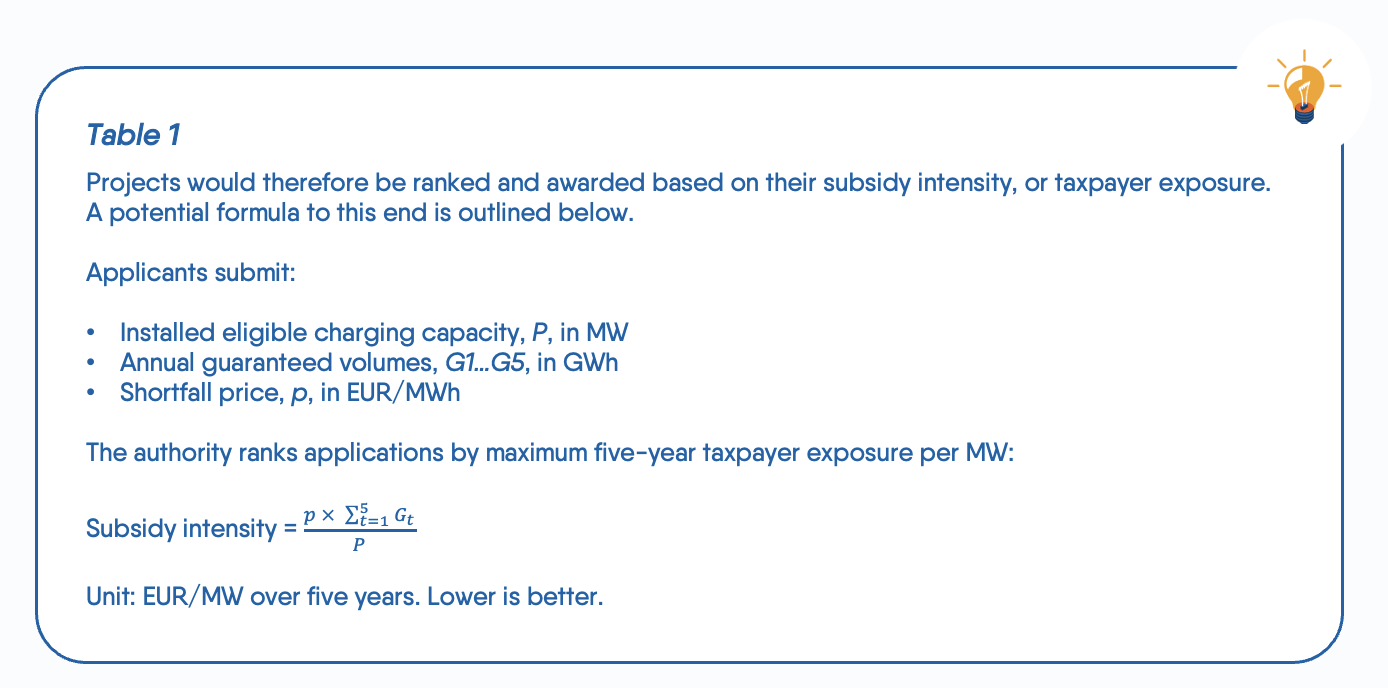
For the purpose of calculating this subsidy intensity, the public authority would either set a standardised compensation price for the purpose of calculating support [6] or, alternatively, CPOs could submit a price themselves as part of their application. Eligibility could be limited to planned or newly developed public sites that are compliant with AFIR requirements. Beyond one-sided guarantees covering downside risk only, a two-sided model could be envisaged in which better-than-expected performance would also entail partial upside-sharing with the public authority.
The main strength of this type of instrument is that it addresses the core de-risking challenge directly. By underwriting part of the downside risk associated with low early utilisation, it could improve project bankability, reduce financing costs and facilitate capital allocation for first-mover investments. It would also create a relatively clear and direct relationship between public support and the market failure the instrument is meant to address.
Further design questions would concern, among other things, the precise duration and level of the utilisation floor, the share of any shortfall covered by the guarantee, and the treatment of performance above the guaranteed level. Any mechanism should be designed to ensure simplicity, comparability, economic realism and avoid adverse incentives.
B) Subsidised offtake / demand-commitment model
A second possible approach would be to support medium-term demand commitments between charging operators and fleet operators, either directly or via intermediaries such as eMSPs, which could aggregate demand from multiple fleet operators, with the aim of making future public charging demand more visible and bankable. Rather than underwriting low utilisation directly on the supply side, this model would seek to stimulate both vehicle uptake and charging investment by reducing the cost of public charging for fleet operators in return for a longer-term commitment to use public charging networks.
In practice, such a mechanism could take the form of a temporary public subsidy awarded to fleet operators, or to Mobility Service Providers aggregating their demand, and linked to charging volumes covered by an offtake agreement with a CPO. By lowering the effective cost of charging over a defined period, the instrument could improve the total cost of ownership for eHDVs and encourage earlier fleet commitments. At the same time, the associated demand commitment could provide charging operators with greater visibility over future volumes and revenues, thereby strengthening the business case for investment in public infrastructure.
Different award procedures could be envisaged. Operators or their intermediaries could simply apply on the basis of a bilaterally agreed offtake agreement with a CPO, with the public authority allocating the subsidy based on transparent eligibility and/or ranking criteria. However, a more standardised model through a public or publicly supported platform could more effectively facilitate matching between eligible parties by hosting standardised offtake offers. Such a platform would provide a level playing field, reduce transaction costs and make the mechanism more accessible, in particular for smaller players. Such a platform would be intended purely to improve visibility of offers and facilitate matching, without replacing demand aggregation and intermediation models offered by private market actors. At the same time, to protect business confidential information, such a platform should not require CPOs to disclose the full commercial details of their offers. The objective would be purely to link public support to credible future charging demand, while preserving flexibility in the underlying commercial relationship between fleets or eMSPs and charging operators.
The main attraction of this model is that it seeks to address both sides of the coordination problem at once. It could help accelerate vehicle uptake by improving the TCO case for eHDVs, while simultaneously providing CPOs with more predictable future demand. In that sense, it may offer a more integrated response than purely supply-side support, particularly if designed in a way that supports market formation in strategic locations or corridors. It could also provide a continued incentive for additional electrification over time, rather than simply insuring operators against low initial utilisation.
However, this model is also more complex. It would need to account for a freight market characterised by subcontracting chains and a large number of SMEs, including potential intermediary actors, to avoid market distortions and ensure smaller operators can participate in practice. To ensure participation in the scheme, the exact duration and structure of the commitments would also need to ensure an appropriate balance between long-term certainty for charging operators and the flexibility needs of logistics operators. Further validation and design work will therefore be needed to ensure fleet operators would be willing to accept a commitment period long enough to support bankable investment decisions. Lastly, further design work would be needed on how committed volumes are defined, monitored and enforced in practice, including how the mechanism would respond where actual charging volumes fall materially short of those originally committed.
Conclusion
The measures set out in this paper reflect two distinct levels of ambition. Short-term adjustments to existing instruments are readily actionable and can meaningfully ease friction in project deployment. However, they leave the central problem currently holding back investment in eHDV charging infrastructure untouched: in the early years of market development, demand for public eHDV charging remains too uncertain to support investment at the pace and scale required.
Addressing that core problem directly requires the kind of targeted de-risking instruments outlined in Section II of this paper. Further design work will be needed to calibrate the level and duration of support, ensure competitive and proportionate allocation, and avoid unintended distortions or adverse incentives. Still, in order to enable the rollout of eHDV charging infrastructure at the scale and pace required, instruments that directly target early-stage utilisation risk must move from the margins of the policy debate to its centre.
[1] Where depot charging is concerned, in case regulators opt for its inclusion, the logic of this paper is relevant primarily where such infrastructure is made semi-publicly available to third-party use; purely private depot infrastructure does not face the same demand uncertainty.
[2] https://www.chargeupeurope.eu/positions/de-risky-business
[3] For example, Poland’s 2025 NFOŚiGW electromobility funding scheme uses two jointly assessed funding streams: one supporting DSO-level grid infrastructure and another supporting public HDV charging infrastructure. The scheme allows up to 100% funding of eligible grid costs and links charging infrastructure support to secured power supply from the DSO, thereby addressing grid readiness as a distinct but integrated part of the investment.
[4] NB: this would not amount to a reference or market price, i.e. it would not indicate a “fair” price for CPOs - instead it just defines which part of the cost would be to be covered.
Don't Pull the Plug on Battery Data: Possible Amendment of Article 20a(3) of the Renewable Energy Directive – in the context of the Post-2030 Renewable Energy Framework Consultation
In the context of the consultation on the renewable energy framework beyond 2030, ongoing debates on the Automotive Omnibus and the possible revision of the Renewable Energy Directive, we would like to stress the importance of maintaining EV battery data sharing obligations included in Article 20a(3) of the RED on access to battery-related data.
The post‑2030 framework should strengthen and implement the core principles of Article 20a(3), i.e. real‑time, non-discriminatory and free-of-charge access to essential EV battery data for owners/users and authorized third parties acting on their behalf, with appropriate safeguards (consent, data protection and cybersecurity). It should also reinforce the fact that maintaining a non-discriminatory access to data that supports fair competition is key, but isn't enforced in today's market where OEMS have full and opaque control of the battery data.
First, these provisions are essential for the development of diverse business models. Charge Point Operators (CPOs) and other market actors rely on real-time battery data (state of charge, state of health, capacity, power set points) to operate efficiently, offer smart charging services and participate in flexibility markets. Without reliable access to this data, many of these services would not be economically viable. Article 20a(3) targets a defined set of data points (SoC, SoH, battery capacity, power set point and, where appropriate, location), which are necessary to deliver safe and reliable smart charging and flexibility services.
Second, the current rules are important for consumer transparency. They ensure that users, or third parties acting on their behalf with consent, can access meaningful information about their batteries at no cost. This allows consumers to make informed choices and engage in new energy services. Weakening these provisions would risk creating information imbalances. This access should ensure users retain control while enabling trusted third‑party services.
Third, data access is a key enabler of system integration. The increasing share of renewable electricity requires better use of flexible assets such as electric vehicles and battery storage. In particular, access to accurate, real-time battery data is essential for the development of Vehicle-to-Everything (V2X) services, including vehicle-to-grid and vehicle-to-home applications. These services depend on precise information on battery status and availability to safely and efficiently feed electricity back to the grid or buildings. Standardized and accessible data therefore underpins both grid optimization and the scaling of V2X solutions.
Fourth, Article 20a(3) provides legal certainty. A clear and harmonized EU framework avoids fragmentation between Member States and supports investment decisions. This is particularly important for actors operating across borders. The Commission has already highlighted the importance of a uniform approach to implementation to avoid divergent national interpretations (Here).
Finally, maintaining non-discriminatory access to data supports fair competition. It prevents situations where access to essential information is restricted, which could otherwise limit innovation and reduce consumer choice.
We also recognize the importance of ensuring that battery data sharing obligations are appropriately reflected within type-approval legislation; however, this should not be interpreted as a justification for weakening or removing these corresponding obligations under the Renewable Energy Directive. We recognize the need for coherence with type‑approval rules, but coherence must mean “alignment without dilution”: whether these obligations sit in energy law, type‑approval or a complementary instrument, the post‑2030 framework should preserve the same substantive rights (real‑time, free‑of‑charge, non‑discriminatory access for owners/users and authorized third parties).
For these reasons, we encourage the Commission to maintain the core principles of Article 20a(3) (EV battery data sharing obligations) in any future revision of the Directive.
Battery co-location as a strategic pillar for accelerating EV infrastructure and strengthening Europe’s power system
Battery co-location at charging sites is key to accelerate Europe’s decarbonization and emobility transition. Yet, today, it remains capital-intensive and constrained by fragmented frameworks, inconsistent permitting procedures, inefficient taxation models, limited access to flexibility markets, and undeveloped Flexible Connection Agreements.
ChargeUp Europe calls for:
Recognition of battery co-location as enabling infrastructure for EV fast charging in EU funding instruments;
Standardized EU accounting rules to ensure that electricity stored in, and discharged from, co-located batteries retains its renewable attribution;
EU action to ensure full and non-discriminatory access to balancing and ancillary services markets for co-located storage at EV charging hubs;
Proportionate EU and Member States frameworks for co-located assets behind the meter (200 kW–1.5 MW batteries);
Streamlined permitting, safety, and grid connection procedures for co-located EV charging and storage infrastructure across Member States.
Recognising battery co-location as a strategic infrastructure component is essential to accelerating EV infrastructure deployment and strengthening Europe’s power system. It will speed up deployment, improve grid resilience, enhance renewable integration, strengthen the business case for operators and safeguard customer experience.
Read the full position paper here
Getting network tariffs right for EV charging
The forthcoming European Commission’s proposal on network tariffs represents an opportunity to modernise tariff frameworks across Europe, ensuring they better support electrification, flexibility and efficient network usage and development.
To achieve this, ChargeUp Europe calls for:
Fit-for-purpose tariff structures that reflect real grid use, support transport electrification, and do not hamper the business case of the sector;
Promotion of smart metering, digitalization and enabling infrastructure;
Regulatory experimentation and structured knowledge sharing across Member States.
The current tariff structures in many Member States heavily rely on static capacity-based charges that do not adequately reflect the operational characteristics of public EV charging infrastructure. By aligning network tariffs with the realities of EV charging, policymakers can avoid unnecessary costs for charging operators and consumers alike, incentivise flexibility and reduce burdens on DSOs.
Read the full position paper here.
Strategic priorities for the 2026 review of AFIR
Ahead of the 2026 review of the Alternative Fuels Infrastructure Regulation (AFIR), ChargeUp Europe has put forward a set of strategic priorities to ensure the framework continues to support the growth of Europe’s EV charging sector.
The upcoming review is a critical opportunity to reinforce Europe’s commitment to an open, competitive, and consumer-focused charging market. To achieve this, the review should focus on:
Maintaining clear, achievable deployment targets that provide certainty for investors;
Reducing regulatory fragmentation and ensuring consistent implementation across Member States;
Strengthening interoperability, data harmonisation, and a seamless charging experience for drivers across Europe.
AFIR must remain a powerful driver of Europe’s transition to electric mobility while continuing to support innovation, competition, and investment in charging infrastructure. A stable and effective framework is essential to deliver affordable, accessible, and reliable charging for all.
Read the full position paper here.
European Grids Package: ChargeUp Europe’s proposed amendments
As part of the ongoing discussions on the European Grids Package, ChargeUp Europe has proposed a set of targeted amendments to better support the rollout of efficient, future-ready recharging infrastructure.
These include:
Update definitions to reflect battery co-location and align with AFIR
Apply permitting thresholds at recharging pool level
Recognise recharging infrastructure as overriding public interest
Extend rules to support hybridisation of stations
Avoid EIAs for small-scale (<1 MW) storage in hybrid pools
Ensure access to Flexible Connection Agreements (incl. >100 kW)
Call for clear EU guidance on FCA implementation
Introduce a single national digital permitting portal These changes aim to remove bottlenecks, improve regulatory clarity, and accelerate the deployment of EV charging networks across Europe.
You can read our full proposal here.
From Constraint to Connection: Flexible Connection Agreements for Charge Point Operators
Timely access to the electricity grid remains the single biggest barrier to the rollout of EV charging infrastructure in Europe. In many regions, grid capacity is either unavailable or highly constrained, leading to costly delays that threaten the pace of EV deployment and undermine the EV driver experience. Without faster and more predictable grid access, charging sites are postponed, investor confidence is weakened, and Europe risks falling short of its electrification and climate goals.
Flexible Connection Agreements (FCAs) can provide a valuable interim solution.
ChargeUp Europe recommendations:
Establish EU-wide minimum standards for FCA contracts – including clear definitions of firm vs. flexible capacity, baseline availability, notice periods, and standardized digital protocols.
Lower thresholds for eligibility – to ensure small and mid-sized CPOs can access FCAs, especially in congested areas, thereby accelerating deployment and supporting transport decarbonization.
Guarantee grid transparency – DSOs must publish substation-level congestion maps, connection queues, and forecasted capacity data to support investment decisions.
Standardize tools and processes – develop model contracts and interoperable APIs, with the Commission setting guidelines, ACER supervising consistency, and NRAs ensuring implementation.
Ensure oversight and accountability – ACER and NRAs should monitor FCA rollout, publish performance metrics, and intervene where access is discriminatory or insufficient.
Equip DSOs to deliver – provide EU-level funding and technical support for DERMS, telemetry, and staff training, particularly for smaller DSOs.
Read the full paper to learn how FCAs can improve the access to the electricity grid.
You can read the full paper on FCAs here.
Transformation ist kein Zufall: Fünf politische Handlungsfelder zur Förderung der Ladeinfrastruktur und Elektrifizierung des Verkehrs in Deutschland
ChargeUp Europe vertritt 40 Mitglieder, die zusammen über 800.000 öffentliche Ladepunkte in der EU betreiben. Die Arbeitsgruppe in Deutschland dient als zentrales Forum für den Dialog zwischen Industrie und Politik auf Bundes- und Landesebene. Wir setzen uns für eine strategische Transformation der Mobilität ein, um die Wettbewerbsfähigkeit und Innovationsführerschaft Deutschlands angesichts von Handelskonflikten, wirtschaftlichem Druck und energiepolitischen Herausforderungen zu sichern
Damit Deutschland an der Spitze der Cleantech-Revolution bleibt, muss es Innovationen vorantreiben, das Vertrauen der Verbraucher gewinnen und langfristige Investitionen in nachhaltige Verkehrslösungen sichern. In diesem Zusammenhang ist ein strategischer und koordinierter Ansatz unerlässlich – gestützt auf einen stabilen regulatorischen Rahmen, technologischen Fortschritten und gezielten Fördermaßnahmen. Nur so kann ein umfassendes und effizientes Elektromobilitäts-Ökosystem entstehen, das eine entscheidende Grundlage für den Übergang zu einem nachhaltigen Verkehrssystem bildet.
Wir schlagen fünf konkrete Maßnahmen vor, um dieses Ziel zu erreichen.
Den vollständigen Bericht der Arbeitsgruppe Deutschland können Sie hier lesen.
Transformation is no coincidence: 5 policy priorities to drive EV charging and transport electrification in Germany
ChargeUp Europe represents 40 members operating more than 800,000 public charging points across the EU. Its Germany Working Group serves as a key forum for dialogue between industry and government at federal and state levels. We advocate for a strategic transformation of mobility to safeguard Germany’s competitiveness and innovation leadership in the face of trade tensions, economic pressures, and energy challenges.
To ensure that Germany stays at the forefront of the clean tech revolution, it must drive innovation, earn consumer trust, and secure lasting investment in sustainable transport solutions. In this regard, a strategic and coordinated approach—underpinned by a stable regulatory framework, technological advancements, and targeted funding measures—is essential to developing a comprehensive and efficient e-mobility ecosystem, which serves as a critical foundation for the transition to sustainable transport. We propose five measures to achieve this.
Read the full paper to learn what actions the industry recommends for Germany to stay up to speed with the mobility of tomorrow.
You can read the full paper of the Germany Working Group here.
Watt’s the Hold-Up? Fixing Grids for E-Mobility
While the European Commission prepares the Grid Package, ChargeUp Europe’s latest paper offers actionable recommendations to ensure that the grid is ready for the future and the rapid expansion of e-mobility.
The recommendations draw on the experience of ChargeUp Europe’s members with deploying charge stations and the challenges they faces while obtaining a grid connection.
ChargeUp Europe recommendations:
Amending Article 6 of the Electricity Directive to include system-benefit-based prioritization and differentiated timelines for connections, based on the energy efficiency first principle.
Harmonizing distribution network development plans (DNDP) through a new legislative proposal to define minimum binding requirements for DSOs when drafting the DNDPs.
Expanding ACER’s mandate to market governance to ensure consistent national regulatory approaches.
Defining a framework for grid aware charging based on flexible network tariffs, flexible connection agreements and broaden the TEN-E scope to incorporate grid digitalization.
Allowing more synergetic funding to combine charging and grid investments in the Alternative Fuels Infrastructure Fund.
Funding to combine charging and grid investments in the Alternative Fuels Infrastructure Fund.
Read the full paper to learn what needs to be done to prepare the grid for the electric needs of tomorrow.
Electrifying Corporate Fleets: Untapped Potential to Sustain EV Demand
Corporate fleets represent one of the most effective and scalable pathways to accelerate EV adoption across Europe. From company cars to delivery vans and logistics vehicles, these fleets account for the majority of new vehicle registrations, and they have the potential to lead the e-mobility transition.
Our new position paper outlines how smart, targeted policy can:
Drive EV uptake across different types of fleets
Support a strong and accessible second-hand EV market
Maximise the impact of public and private investment in charging infrastructure
Strengthen Europe’s clean mobility value chain and industrial competitiveness
The charging infrastructure is ready to scale. What’s needed now is a policy framework that empowers fleet operators to make the switch.
Read the full paper to learn how fleet electrification can deliver on Europe’s climate, economic, and mobility goals.
ChargeUp Europe Board Statement: State of the Industry report provides data on the real strength of the EV charging sector
On 6 June, ChargeUp Europe’s Board discussed the main findings of the third edition of the State of the Industry report, released last month.
The data speaks for itself:
A €15.3 billion industry, directly employing close to 60,000 people today
950,000 public chargers, plus 8.1 million private charging points across the EU
Infrastructure deployment exceeding AFIR targets fourfold
A sector advancing energy independence and grid flexibility through smart and bidirectional charging
By 2035, EVs will represent about 30% of the EU car fleet. Our industry will be worth €94 billion. To stay on track, we need stable, ambitious CO2 targets and policy support at every level.
You can read the full Board statement here.
Simplifying Grid Connection Processes for EV Charging Infrastructure in Europe: Eurelectric Roundtable Conclusion
ChargeUp Europe and Eurelectric co-hosted a roundtable discussion on 1 April to explore best practices and challenges in connecting EV charging infrastructure to the grid. Participants included representatives from DG MOVE, CPOs, technology providers, DSOs from Eurelectric, and DSO associations GEODE and E.DSO.
The discussion highlighted persistent grid capacity constraints across Europe and the need to accelerate the implementation of relevant EU policies such as the Grid Action Plan and Electricity Market Design. Slow and inconsistent transposition at national level continues to hinder progress on electrification.
Participants shared digital tools and solutions already in use, from capacity maps and digital twins to single national contact points, and stressed the need for harmonised data, transparent fees, and real-time connection updates.
The roundtable also emphasised the need for enabling regulatory frameworks and anticipatory investments, with EU funding playing a complementary role. A minimum dataset for connections and digitalisation of DSO processes were identified as urgent priorities.
The event builds on the 2023 MoU between ChargeUp Europe and Eurelectric to jointly address grid connection barriers and support Europe’s clean mobility goals.
ChargeUp Europe’s response to the Measuring Instruments Directive review proposal
ChargeUp Europe’s response to the European Commission’s review proposal on the Measuring Instruments Directive (MID) outlines key technical updates needed to improve EU metrology rules for EV charging.
Our position emphasises:
Harmonisation – A unified approach to measuring instruments across Member States to avoid fragmentation and strengthen the EU Single Market for EV chargers.
Regulatory clarity – Clear, consistent rules across Member States to avoid unnecessary costs for consumers and manufacturers.
Innovation-friendliness – Ensuring regulations remain adaptable to innovation and enables delivering new technological solutions for seamless consumers' experience.
Our key recommendations:
✔ Future-proof standards – Regulations should dynamically adapt to evolving technology and market developments.
✔ Simplified compliance – Streamlining certification and reporting requirements to reduce unnecessary administrative burdens and costs which slow down infrastructure roll-out.
✔ Interoperability – Ensuring uniform technical specifications across all charging networks to enhance accessibility.
✔ Consumer confidence – Maintaining transparency and accuracy in energy measurement to protect users and build trust.
This approach will ensure the regulatory framework supports the continued growth of the European EV charging sector while delivering a reliable, user-friendly experience.
You can read ChargeUp Europe’s response to the MID proposal here.
ChargeUp Europe’s response to public consultation on measuring instruments - Technical update of EU rules
ChargeUp Europe’s response to the European Commission’s public consultation on the Measuring Instruments Directive (MID) outlines key technical updates needed to improve EU metrology rules for EV charging.
Our position emphasises:
Harmonisation – A unified approach to measuring instruments across Member States to avoid fragmentation and strengthen the EU Single Market for EV chargers.
Regulatory clarity – Clear, consistent rules across Member States to avoid unnecessary costs for consumers and manufacturers.
Innovation-friendliness – Ensuring regulations remain adaptable to innovation and enables delivering new technological solutions for seamless consumers' experience.
Our key recommendations:
✔ Future-proof standards – Regulations should dynamically adapt to evolving technology and market developments.
✔ Simplified compliance – Streamlining certification and reporting requirements to reduce unnecessary administrative burdens and costs which slow down infrastructure roll-out.
✔ Interoperability – Ensuring uniform technical specifications across all charging networks to enhance accessibility.
✔ Consumer confidence – Maintaining transparency and accuracy in energy measurement to protect users and build trust.
This approach will ensure the regulatory framework supports the continued growth of the European EV charging sector while delivering a reliable, user-friendly experience.
You can read the MID response paper here.
Joint paper: Shared vision on future development of vehicle-to-everything in the European Union

ACEA, ChargeUp Europe, and SmartEN call on policy makers to ensure the effective functioning of the bidirectional charging market and stimulate user uptake.
The green and digital transformation presents both challenges and opportunities for the automotive sector. As the role of EVs expands, the concept of bidirectional charging—vehicle-to-grid (V2G), vehicle-to-home (V2H), and vehicle-to-everything (V2X)—becomes crucial to managing the energy demands of the transition to zero-emissions mobility.
However, number of regulatory challenges hinder the development of effective business models, necessitating in-depth discussions on the roles and responsibilities of emerging market players.
You can read the joint V2X paper here.
De-Risky Business: Rethinking AFIF for Risk-Free EV Charging Investment
As the European Commission prepares its Automotive Industrial Plan and revisits the Multiannual Financial Framework, ChargeUp Europe’s latest paper offers actionable recommendations to ensure that investments in EV charging infrastructure are effective, equitable, and aligned with 2035 emissions targets.
The recommendations draw on the experience of ChargeUp Europe’s members with existing EU and national funding programs, highlighting areas where the Connecting Europe Facility/Alternative Fuels Infrastructure Facility (CEF/AFIF) and other instruments can evolve to meet the needs of a growing e-mobility market.
ChargeUp Europe recommends:
To maintain and expand CEF-AFIF funding
To account for the grid connection costs in the funding scheme
To introduce an ‘EV grid facility’ in the EU budget
To simplify the rules and procedures to access EU funding, via:
Extension of project timelines in line with permitting and grid connection processes
A more flexible site selection process
More flexibility in financing models for grant application
Less burdensome administrative process and application procedures
To introduce a EU-level monitoring system on the use of EU funds.
By addressing key challenges such as high fixed costs, grid connection bottlenecks, and administrative burdens, these recommendations aim to unlock investment potential and support a fair, pan-European rollout of EV charging infrastructure.
Read the full paper here.
Joint Letter to Commissioner Designates
Ahead of the hearings of incoming European Commissioners that begin today, ChargeUp Europe, AVERE, Eurelectric and EuropeOn reiterate the importance of sticking to 2035 zero-emission targets for cars and vans and the intermediate goals starting next year.
The 2035 framework is crucial for investment certainty across Europe’s EV ecosystem. A slowdown would jeopardise Europe’s competitiveness in an increasingly electrified market. Now is the time to double down and accelerate, not slow down or prevaricate.
We call on the incoming Commissioners, particularly Executive Vice President-designates Teresa Ribera and Stéphane Séjourné and Commissioner-designates Wopke Hoekstra and Apostolos Tzitzikostas, to seize the opportunities in e-mobility!
You can read the joint letter here.
Harder, Better, Faster, Stronger: Reducing Administrative Roadblocks for the EV Charging Industry - Input for the European Commission
The European Union has recognized the need to reduce administrative burdens, particularly for businesses in the EV charging infrastructure sector, which is crucial to the green and digital transition. ChargeUp Europe's latest paper delves into the significant challenges posed by complex administrative processes, including non-standardized permitting, VAT registration hurdles, and fragmented national regulations.
This paper:
- Maps out the key roadblocks that companies face when navigating the intricate and often divergent administrative processes across the EU, with particular focus on the EV charging infrastructure industry.
- Presents insights gathered from ChargeUp Europe’s consultation with members, identifying both the horizontal challenges, such as lack of process harmonization, and specific burdens like permitting and grid connection delays, which significantly hinder the industry's growth.
- Engages EU policymakers and stakeholders to propose actionable recommendations, such as standardizing permitting processes, improving VAT compliance mechanisms, and ensuring easier access to EU funding, all aimed at fostering a more business-friendly environment for the sector.
A simplified and harmonized approach to administrative processes will not only enhance operational efficiency for companies but also accelerate the deployment of EV infrastructure across Europe.
Read the full paper here.
Joint Statement on the key role of distribution grids for a competitive, green and resilient Europe
Together with a coalition of 16 other European cross-sectoral associations, we support the call to maintain the distribution grid at the centre of the EU agenda!
In the joint statement by DSO Entity, the coalition explains that Distribution System Operators (DSOs) are central players that contribute to driving the energy and digital transition on the ground for the benefit of all European citizens, enterprises, and industries. The distribution grids are incorporating an increasing amount of renewables and are becoming more customer driven. DSOs are the key technical enablers of the 42.5% EU’s renewable energy target, as more than 70% of renewables will be connected to the distribution grid by 2030. This will see more than 30 million electric vehicles (EVs) on the roads by 2030.
In particular, we support the calls to:
Align EU financing instruments with net-zero targets and DSOs’ needs
Introduce a grid mainstreaming approach to ensure that grid expansion doesn't lag behind.
As the #1 bottleneck to the rapid and widespread rollout of charging infrastructure across Europe, strengthening grid infrastructure is a core priority of ChargeUp Europe.
Policymakers must treat it as such.
You can read the joint statement here, or find it on DSO Entity’s website.