
Please Plug the Gap Between the Truck and the (Charging) Station: Breaking the eHDV Investment Deadlock
Introduction
The electrification of heavy-duty road transport will require a rapid and large-scale rollout of dedicated charging infrastructure across Europe. Yet while the policy debate often focuses on rollout targets and upfront capital expenditure, a central obstacle remains insufficiently addressed: in the early years of market development, demand for public eHDV charging is too uncertain to support investment at the pace and scale required.
eHDV charging infrastructure is capital-intensive and grid-intensive, with long payback periods. Investors typically rely on anchor customers or long-term offtake agreements, yet these are difficult to secure in a market where fleet uptake depends on multiple factors — including total cost of ownership (TCO), operational requirements, vehicle availability and route structures — and where the pace and timing of the transition remains highly uncertain. This uncertainty is not only commercial, but also policy-driven: while a stable and supportive framework for eHDV uptake can strengthen confidence in future demand, recent developments — including the postponement of ETS2 to 2028 and additional flexibility in HDV CO2 standards — have further weakened short-term visibility on the likely pace of e-truck adoption. Similarly, while some Member States are looking to introduce demand-side measures such as decarbonisation targets for shippers, these are enjoying limited political momentum at EU level.
As a result, charging operators cannot reliably predict early utilisation or revenue trajectories. For lenders and investors, this makes it difficult to assess whether and when a project will become commercially viable. Projects may therefore face significantly higher financing costs as the risk of low early utilisation is priced in, or struggle to secure funding at all.
Existing public support instruments can help reduce upfront investment costs, but they do not by themselves solve the problem of low and uncertain utilisation in the first years of operation. Other barriers — such as high grid connection costs, long lead times, permitting delays and fragmented implementation — remain relevant and can further weaken project economics, but are secondary to, or closely linked with, the underlying issue of uncertain demand.
The result is a familiar coordination problem: charging infrastructure providers hesitate to invest without credible demand; fleet operators delay commitments until TCO is favourable and infrastructure is in place; and manufacturers cannot scale vehicle sales without commitments from either side. This dynamic slows market activation, even where long-term demand is clear.
This paper seeks to outline possible approaches to resolve this coordination problem, prioritising approaches that target early-stage deployment where risk is highest, provide partial risk coverage in order to preserve market incentives, avoid excessive administrative or implementation complexity, and do not grant specific actors disproportionate control over the wider ecosystem. Measures should also be coherent with existing frameworks such as AFIR, AFIF and InvestEU, adaptable to different use cases and locations [1], and sufficiently scalable and replicable to support wider market rollout.
Not all measures are created equal. Some can be implemented quickly within existing frameworks and may improve investment conditions at the margins. Others are more complex to design and deploy, but more directly address the core challenge of early-stage utilisation risk.
The paper therefore adopts a structured “menu” approach, ranging from readily implementable measures to more ambitious de-risking mechanisms. The aim is not to present interchangeable options, but to distinguish clearly between incremental improvements and those measures with the potential to unlock investment at scale.
Short-term adjustments to existing instruments
Lower ambition, limited but near-term impact
A first category of measures consists of relatively simple adjustments to existing funding instruments that could improve investment conditions for eHDV charging infrastructure in the short term. In particular, ChargeUp Europe has already laid out recommendations to adapt the Alternative Fuels Infrastructure Facility (AFIF) in 2025 [2], which are mirrored in our recommendations below.
These measures are lower in ambition than dedicated de-risking mechanisms and do not directly resolve the core challenge of uncertain early utilisation. However, they may still alleviate cost, timing and administrative constraints, and are therefore worth considering as part of a broader policy response:
A) Longer and more flexible implementation timelines
In many cases, the timeline for public eHDV charging projects is determined less by the charging equipment itself than by permitting and, above all, grid connection processes, which are out of the control of the charging operator. Existing funding frameworks should therefore not only allow for extensions where justified, but proactively provide longer and more realistic implementation timelines in call design from the outset, better reflecting the realities of permitting and grid connection processes. The current mismatch is already causing hesitance among companies to apply for funding, and where funding is rewarded ultimately viable projects may lose support, be delayed, or fail to proceed, simply because administrative or grid-related lead times are longer than assumed under existing schemes.
B) Better account for grid connection costs in AFIF and similar schemes
For large public eHDV charging hubs, grid connection costs can represent a significant share of total project costs and may be substantially higher than for standard LDV charging sites. While grid connection costs are in principle eligible under the AFIF co-funding scheme, current funding structures do not adequately reflect the scale and variability of grid investments required for eHDV infrastructure. As a result, a substantial portion of grid-related costs remain insufficiently addressed. A first priority should therefore be to ensure that AFIF and similar instruments better account for the grid connection costs associated with eHDV charging infrastructure.
This could include reimbursement mechanisms that cover eligible grid connection costs at an early project stage, rather than only after charging revenues begin to materialise, following the good practice of existing national examples [3]. Simplifying the administrative process for obtaining such support — for example through more streamlined application procedures — could further improve the effectiveness of such mechanisms.
C) More flexible site-selection and design rules
Rigid site-selection requirements may exclude technically or commercially viable locations with better grid access or more realistic deployment prospects (e.g. AFIF requirement to be within three km from the TEN-T network). This issue may be even more pronounced for large eHDV hubs, which have more demanding space and power requirements than LDV charging sites. To the extent that existing funding instruments add avoidable rigidity, these should be made more flexible. More fundamentally, however, the forthcoming AFIR review should assess whether the current siting logic remains fit for purpose for eHDV charging infrastructure, given the particular space and grid requirements of large public hubs.
Similar flexibility may also be warranted in regard to technology and site design. For example, while MCS is likely to become increasingly widespread and important for HDV charging over the coming years, allowing some flexibility in choice and configuration of charging technologies could enable site developers to optimise sites according to available power, space and operational requirements and avoid narrowing investment choices prematurely.
D) Simplified application and financing requirements
A further short-term improvement would be to reduce unnecessary administrative burdens and allow greater flexibility in financing models under existing support schemes. Burdensome procedures, rigid blending requirements and restrictive maturity criteria can create additional barriers for project promoters in an already complex and uncertain market environment. Existing public support frameworks could also operate more effectively through better coordination and project assessment, including, for example, a more consistent approach to the validity assessment of projects for Member State financing at EU level. Simplification would not address the core market failure directly, but it could improve access to support and help accelerate project development where viable business cases already exist.
Taken together, these measures could improve investment conditions and reduce friction in the deployment process. They may therefore represent realistic near-term actions for policymakers. At the same time, their impact should not be overstated. While such measures may improve investment conditions and remove avoidable friction, they are unlikely to create the step change in investment outlook needed to accelerate rollout at scale. More fundamentally, relying too heavily on CAPEX-side improvements alone risks supporting infrastructure deployment without sufficiently addressing the underlying challenge of predictable early demand, and may therefore incentivize stranded assets.
New de-risking instruments
High ambition, highest potential impact
The following section turns to more ambitious de-risking instruments aimed directly at the core challenge identified in this paper: low and uncertain utilisation in the early years of operation. Unlike the more limited and indirect measures outlined above, these approaches seek to improve bankability by providing greater visibility over future revenues or demand. The two options set out below reflect different ways of doing so: one by directly underwriting part of the downside risk faced by charging operators, the other by supporting demand commitments that make future utilisation more predictable.
A) Utilisation / revenue guarantee
One possible approach would be to provide public support in the form of a temporary utilisation or revenue guarantee for public eHDV charging operators. The logic of such an instrument would be to address the central problem identified throughout this paper in a direct and targeted way: if early utilisation remains too uncertain for projects to be underwritten on normal commercial terms, a limited public guarantee could help provide the minimum level of revenue visibility needed to unlock investment.
Such an approach would not eliminate commercial risk altogether, nor should it seek to do so. Rather, it would aim to provide partial and time-limited downside protection, calibrated in a way that preserves incentives for operators to attract demand, optimise site performance and compete on service quality.
In practice, such a mechanism could provide time-limited support covering the first years of operation, for example by underwriting part of the utilisation or revenue ramp-up over an initial 3–5 year period following site completion (i.e. after the site becomes fully operational.) Operators would bid for the level of utilisation they seek to have underwritten. Where actual utilisation falls below the underwritten floor, the guarantee would cover part of the resulting revenue shortfall.
Support should be allocated competitively, with applications ranked according to the level of public support required to provide the proposed utilisation floor. One potentially promising approach in this context would be to normalise bids according to the maximum potential public exposure relative to installed charging capacity, thereby providing a common metric for comparing and ranking project proposals of differing scale, and limiting public support to the minimum necessary (see Table 1).
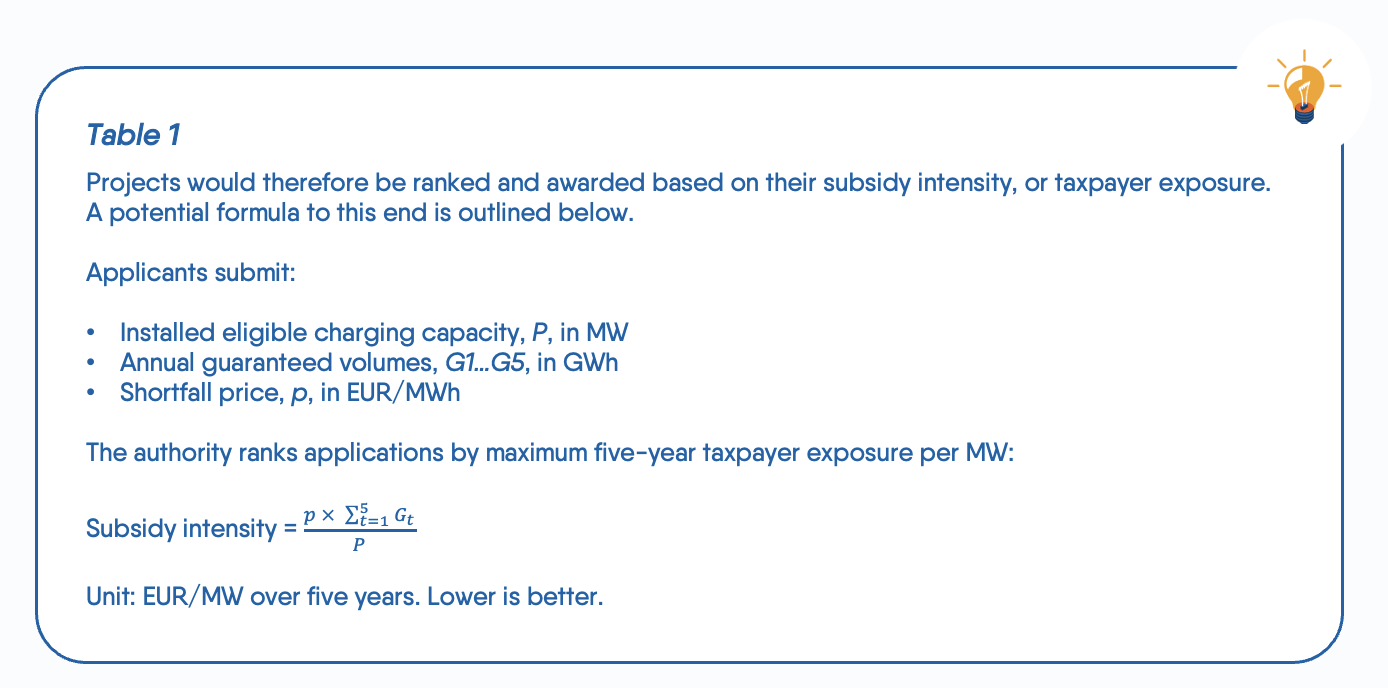
For the purpose of calculating this subsidy intensity, the public authority would either set a standardised compensation price for the purpose of calculating support [6] or, alternatively, CPOs could submit a price themselves as part of their application. Eligibility could be limited to planned or newly developed public sites that are compliant with AFIR requirements. Beyond one-sided guarantees covering downside risk only, a two-sided model could be envisaged in which better-than-expected performance would also entail partial upside-sharing with the public authority.
The main strength of this type of instrument is that it addresses the core de-risking challenge directly. By underwriting part of the downside risk associated with low early utilisation, it could improve project bankability, reduce financing costs and facilitate capital allocation for first-mover investments. It would also create a relatively clear and direct relationship between public support and the market failure the instrument is meant to address.
Further design questions would concern, among other things, the precise duration and level of the utilisation floor, the share of any shortfall covered by the guarantee, and the treatment of performance above the guaranteed level. Any mechanism should be designed to ensure simplicity, comparability, economic realism and avoid adverse incentives.
B) Subsidised offtake / demand-commitment model
A second possible approach would be to support medium-term demand commitments between charging operators and fleet operators, either directly or via intermediaries such as eMSPs, which could aggregate demand from multiple fleet operators, with the aim of making future public charging demand more visible and bankable. Rather than underwriting low utilisation directly on the supply side, this model would seek to stimulate both vehicle uptake and charging investment by reducing the cost of public charging for fleet operators in return for a longer-term commitment to use public charging networks.
In practice, such a mechanism could take the form of a temporary public subsidy awarded to fleet operators, or to Mobility Service Providers aggregating their demand, and linked to charging volumes covered by an offtake agreement with a CPO. By lowering the effective cost of charging over a defined period, the instrument could improve the total cost of ownership for eHDVs and encourage earlier fleet commitments. At the same time, the associated demand commitment could provide charging operators with greater visibility over future volumes and revenues, thereby strengthening the business case for investment in public infrastructure.
Different award procedures could be envisaged. Operators or their intermediaries could simply apply on the basis of a bilaterally agreed offtake agreement with a CPO, with the public authority allocating the subsidy based on transparent eligibility and/or ranking criteria. However, a more standardised model through a public or publicly supported platform could more effectively facilitate matching between eligible parties by hosting standardised offtake offers. Such a platform would provide a level playing field, reduce transaction costs and make the mechanism more accessible, in particular for smaller players. Such a platform would be intended purely to improve visibility of offers and facilitate matching, without replacing demand aggregation and intermediation models offered by private market actors. At the same time, to protect business confidential information, such a platform should not require CPOs to disclose the full commercial details of their offers. The objective would be purely to link public support to credible future charging demand, while preserving flexibility in the underlying commercial relationship between fleets or eMSPs and charging operators.
The main attraction of this model is that it seeks to address both sides of the coordination problem at once. It could help accelerate vehicle uptake by improving the TCO case for eHDVs, while simultaneously providing CPOs with more predictable future demand. In that sense, it may offer a more integrated response than purely supply-side support, particularly if designed in a way that supports market formation in strategic locations or corridors. It could also provide a continued incentive for additional electrification over time, rather than simply insuring operators against low initial utilisation.
However, this model is also more complex. It would need to account for a freight market characterised by subcontracting chains and a large number of SMEs, including potential intermediary actors, to avoid market distortions and ensure smaller operators can participate in practice. To ensure participation in the scheme, the exact duration and structure of the commitments would also need to ensure an appropriate balance between long-term certainty for charging operators and the flexibility needs of logistics operators. Further validation and design work will therefore be needed to ensure fleet operators would be willing to accept a commitment period long enough to support bankable investment decisions. Lastly, further design work would be needed on how committed volumes are defined, monitored and enforced in practice, including how the mechanism would respond where actual charging volumes fall materially short of those originally committed.
Conclusion
The measures set out in this paper reflect two distinct levels of ambition. Short-term adjustments to existing instruments are readily actionable and can meaningfully ease friction in project deployment. However, they leave the central problem currently holding back investment in eHDV charging infrastructure untouched: in the early years of market development, demand for public eHDV charging remains too uncertain to support investment at the pace and scale required.
Addressing that core problem directly requires the kind of targeted de-risking instruments outlined in Section II of this paper. Further design work will be needed to calibrate the level and duration of support, ensure competitive and proportionate allocation, and avoid unintended distortions or adverse incentives. Still, in order to enable the rollout of eHDV charging infrastructure at the scale and pace required, instruments that directly target early-stage utilisation risk must move from the margins of the policy debate to its centre.
[1] Where depot charging is concerned, in case regulators opt for its inclusion, the logic of this paper is relevant primarily where such infrastructure is made semi-publicly available to third-party use; purely private depot infrastructure does not face the same demand uncertainty.
[2] https://www.chargeupeurope.eu/positions/de-risky-business
[3] For example, Poland’s 2025 NFOŚiGW electromobility funding scheme uses two jointly assessed funding streams: one supporting DSO-level grid infrastructure and another supporting public HDV charging infrastructure. The scheme allows up to 100% funding of eligible grid costs and links charging infrastructure support to secured power supply from the DSO, thereby addressing grid readiness as a distinct but integrated part of the investment.
[4] NB: this would not amount to a reference or market price, i.e. it would not indicate a “fair” price for CPOs - instead it just defines which part of the cost would be to be covered.